
Imagine the psychological weight of being gaslit by your own nation’s founding document. You are told you have rights, yet when the highest stakes of democracy—a presidential election—are on the line, the law creates a “judicial blackout.” It tells you that once a winner is declared, the matter is closed forever. No evidence, no irregularity, and no level of misconduct can open the doors of a courtroom.
On 6 March 2026, the African Court on Human and Peoples’ Rights (AfCHPR) in Arusha finally broke that silence. In the landmark judgment of Ado Shaibu and Others v. United Republic of Tanzania, the Court addressed a fundamental democratic deficit: what happens when a country’s highest law provides constitutional immunity for election results, effectively stripping citizens of their right to complain?
The case, brought by members of the Alliance for Change and Transparency—including Ado Shaibu, Ezekiah Dibogo Wenje, and Ms. Dorah Seronga Wangwe—challenged the very fabric of the 1977 Tanzanian Constitution. It was a high-stakes confrontation between the traditional shield of national sovereignty and the evolving standards of continental human rights oversight.
The “Unchallengeable” Presidential Result
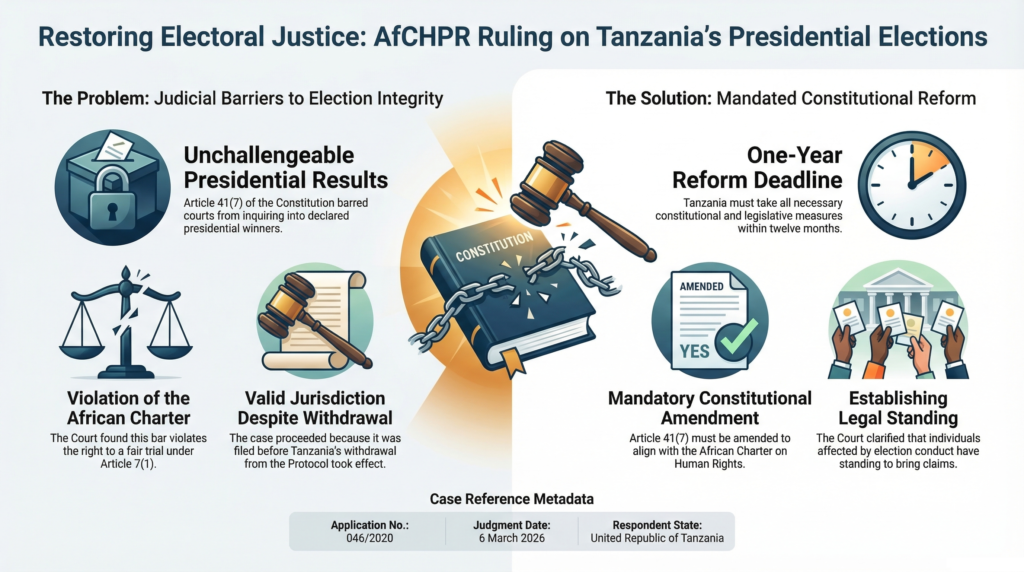
At the center of this jurisprudential storm was Article 41(7) of the Tanzanian Constitution. This provision acts as a legal fortress, barring any court from inquiring into the election of a presidential candidate once the Electoral Commission has made its declaration. For the Applicants, this wasn’t just a procedural quirk; it was a total denial of justice.
The Court found this provision deeply problematic, viewing it as a violation of the “right to be heard.” By insulating the results from scrutiny, the State effectively created a vacuum where accountability could not exist. This finding is a sharp rebuke to the notion of absolute sovereignty; it suggests that “finality” in domestic law cannot be used as a cloak for human rights violations.
In a decisive move, the Court linked this failure not just to the right to a fair trial, but to the state’s fundamental duty to give effect to the African Charter. The Court was explicit:
“[A]rticle 41(7) of the Respondent State’s Constitution, in so far as it bars courts from inquiring into the election of a presidential candidate who has been declared elected by the Electoral Commission, violates Article 1 and 7(1) of the Charter.”
Beating the Clock: The Last-Minute Filing
The drama of this case was heightened by its ticking clock. In November 2019, Tanzania withdrew its Article 34(6) Declaration—the specific legal instrument that allows individuals to bring cases directly to the African Court. This withdrawal was a major blow to regional judicial oversight, and it was set to take effect on 22 November 2020.
In a display of remarkable procedural precision, Ado Shaibu and his co-applicants filed their case on 20 November 2020. They reached the Court barely 48 hours before their right to direct access would have vanished into thin air.
The Court’s analysis of this timeline provided a significant legal insight. While 10 years, 6 months, and 22 days had passed since Tanzania first deposited its Declaration in 2010, the Court ruled that the application was still timely. Why? Because the violation created by Article 41(7) is “continuing.” As long as the unconstitutional provision remains in the books, the window for justice never truly closes.
The Myth of “Purely Local Issues”
Tanzania fought hard to keep the Court out of its internal affairs, raising a stiff objection to the Court’s material jurisdiction. The State argued that the matters raised—specifically the conduct of the 2020 general elections—fell “purely under the jurisdiction of its national courts.”
The Court dismantled this defense with clinical efficiency. It asserted that its power is not dictated by how a state labels an issue, but by whether that issue touches upon the African Charter. If a citizen alleges a violation of a protected right, the Court has the mandate to intervene, regardless of national boundaries.
“[The Court] is empowered to determine applications which raise alleged violations of rights guaranteed by the Charter, the Protocol or any other human rights instruments ratified by the Respondent State.”
The “Climate of Fear” vs. Legal Reality
Perhaps the most intellectually sharp aspect of the ruling was how the Court handled the “exhaustion of local remedies.” The Applicants argued they shouldn’t have to use Tanzanian courts first because of a pervasive “climate of fear” in the country.
However, the Court showed its commitment to legal rigor over political rhetoric by rejecting this claim. It noted that the Applicants provided only “unsubstantiated general statements” about the political atmosphere. For an international court to maintain credibility, it must demand evidence, not just narratives.
Crucially, the Court admitted the challenge to the presidential election results only because a local remedy was legally impossible. Because Article 41(7) literally forbade national judges from hearing the case, there was no “remedy” to exhaust. This surgical distinction—rejecting the political excuse while accepting the legal reality—underscores the Court’s role as a neutral arbiter of law.
A Remedial Order for Constitutional Change
The judgment concludes with a rare and heavyweight directive. Having found a violation of Articles 1 and 7(1), the Court issued a formal remedial order: the United Republic of Tanzania must take all necessary constitutional and legislative measures to amend Article 41(7) of its Constitution.
The State has been given a strict one-year deadline to align its founding document with the African Charter. For a sovereign nation to be ordered by an international body to rewrite its own Constitution is a massive jurisprudential shift. It signals that the “no-go zones” of national law are no longer off-limits to the reach of human rights.
Conclusion: A New Precedent for African Democracy
The ruling in Ado Shaibu and Others is a watershed moment for the protection of political rights across the continent. It reinforces the principle that no law, not even a national constitution, is above the fundamental right to a fair trial and the scrutiny of an independent judiciary.
As the one-year clock for Tanzania’s constitutional amendment begins to tick, it raises a provocative question for every member state of the African Union: In an era of global human rights standards, can any nation truly claim that its laws are “unchallengeable”?

FIAE Ass. Director of Programs & Law lecturer, Prince Sultan University